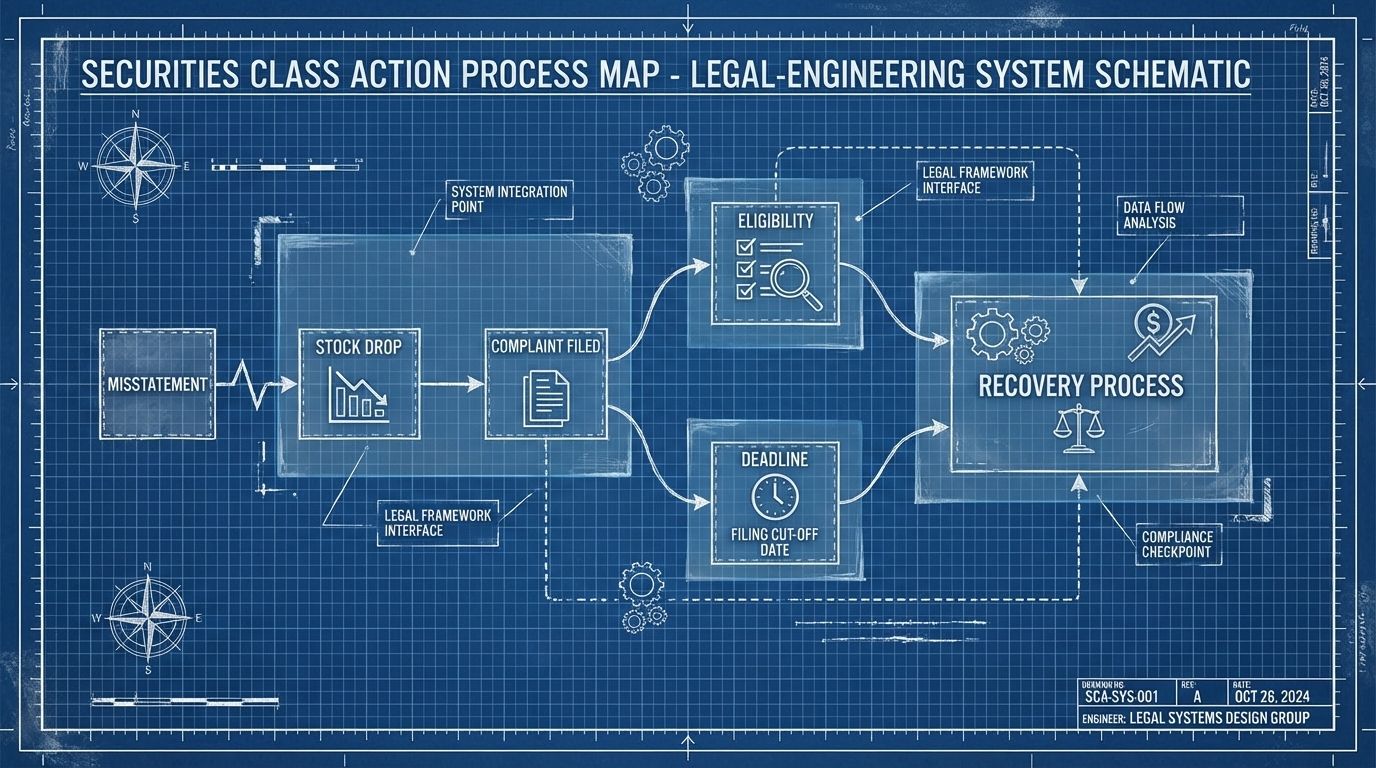
A Complete Guide to Securities Class Action Lawsuits for Investors
A complete guide to securities class action lawsuits covering how they work, key legal concepts, timelines, settlement processes, and what investors should expect when participating.


Key warning signs of misleading financial statements and how investors can spot them.
Financial statements serve as the foundation for investment decisions, yet they can sometimes present misleading information that affects investor outcomes. According to available data, in the first 10 months of 2024, 140 U.S. public companies announced that their previous financial statements required restatements, a nine-year high. Understanding how to identify warning signs in financial reporting may help investors make more informed decisions and approach their portfolios with appropriate care.
Financial statements consist of four main components that work together to present a company's financial position. The balance sheet shows assets, liabilities, and equity at a specific point in time. The income statement reports revenues, expenses, and net income over a period. The cash flow statement tracks actual cash movements from operations, investing, and financing activities. The statement of shareholders' equity shows changes in ownership interests. These documents are expected to provide accurate and complete information.
However, companies may present financial information in ways that can mislead investors through various practices ranging from aggressive accounting interpretations to fraudulent misrepresentations. The distinction matters because the consequences can be significant for those who rely on this information.
Misleading financial statements may affect stock prices and investor decisions. When inaccuracies come to light, stock prices can decline substantially. Historical cases show that companies involved in accounting fraud have experienced equity value losses ranging from 8.8% to 24.5% according to research on U.S. firms. Investors who purchased shares based on inflated financial metrics may face losses when corrections occur.
The spectrum of financial reporting issues ranges from aggressive but legal accounting practices to fraudulent violations. Fraud involves deliberate, illegal deception such as fabricating transactions. Aggressive accounting operates within technical compliance but pushes boundaries. Earnings management involves practices like timing discretionary expenses or adjusting reserves to smooth results. According to survey data, approximately 27% of executives from Russell 3000 companies reported that their firms engaged in some form of earnings manipulation (excluding outright fraud) at least once between 2018 and 2023.
Accurate financial reporting matters because investors rely on this information to evaluate companies and make buy, sell, or hold decisions. Material facts-information that a reasonable investor would consider important-form the basis for informed investment choices. When investors lack the expertise to detect sophisticated manipulation, transparent disclosures become particularly important. U.S. adults averaged 49% correct answers on financial literacy assessments in 2025, highlighting the reliance many investors place on accurate company disclosures.
Companies may inflate revenue through several methods. These include recording sales before goods are shipped or services are delivered, creating fictitious transactions, or engaging in channel stuffing by shipping excess products to distributors with implicit understandings about returns. Companies may also understate allowances for uncollectible accounts, which inflates net revenue. These practices can serve various purposes, such as meeting earnings targets, supporting stock prices, or qualifying for performance-based compensation. Revenue manipulation often appears in cases where receivables grow faster than sales, suggesting that reported revenue may not reflect actual cash collection.
Expense understatement can inflate earnings by reducing reported costs. Companies may fail to record legitimate expenses, improperly capitalize operating expenses as assets, or manipulate depreciation assumptions by extending asset useful lives beyond reasonable estimates. Some companies create reserves during profitable periods and draw them down during weaker periods to smooth earnings. These practices can violate generally accepted accounting principles, which require expenses to be matched with related revenues in the same period. Investors may detect expense manipulation by comparing a company's depreciation assumptions, capitalization policies, and reserve levels to industry peers.
Companies may conceal liabilities or inflate assets through various arrangements. Off-balance-sheet structures can hide debt obligations. Asset values may be overstated by failing to recognize impairments, carrying obsolete inventory at original cost, or maintaining fixed assets beyond their useful lives without appropriate write-downs. Warning signs include financial results that show profits without corresponding positive cash flow, declining asset turnover ratios despite revenue growth, or large year-end adjustments. These patterns may indicate that assets are overvalued or liabilities are understated.
Regulations require disclosure of off-balance-sheet arrangements in Management's Discussion and Analysis sections of SEC filings. Companies must disclose special purpose entities, guarantees, and other arrangements that could affect liquidity or capital resources. However, the complexity of these structures can obscure risks. Suspicious arrangements may include entities with ongoing company involvement, asset sales with repurchase agreements, or contingencies not adequately disclosed. If financial ratios improve without corresponding changes in balance sheet items, it may suggest that obligations exist off-balance-sheet.
Historical cases illustrate these practices. WorldCom improperly capitalized approximately $11 billion in operating expenses, overstating earnings and assets. Enron used special purpose entities to conceal debt and omitted investment losses, leading to shareholder losses and bankruptcy. These cases involved senior management direction, persisted over multiple years, and resulted in significant investor losses and criminal prosecutions.
Revenue and operating cash flow typically show some alignment. After adjusting for non-cash items like depreciation, reported earnings should generally track with cash generated from operations. When revenue grows significantly while cash flow lags or declines, it may indicate that sales are being recorded before cash is collected. Specific patterns that may warrant attention include rapid revenue increases without corresponding cash flow growth, high concentrations of sales at period-end, or discrepancies between cash balances reported on different statements. Comparing revenue growth rates to operating cash flow growth rates over several quarters can help identify potential issues.
Companies may change accounting methods for legitimate reasons, such as new regulations or improved estimates. However, frequent or unexplained changes, particularly those that boost current earnings, may deserve closer examination. Changes in depreciation methods, revenue recognition policies, or reserve calculations can significantly affect reported results. Investors should watch for footnote disclosures about changes in accounting policies or restatements. Multiple changes over a short period, or alterations that make peer comparisons difficult, may signal potential concerns.
Many companies report non-GAAP earnings measures that exclude certain items to show "adjusted" results. According to research, 71% of S&P 500 companies reported non-GAAP earnings in their 2024 annual earnings releases, with 89% showing non-GAAP earnings higher than GAAP figures. Non-GAAP EPS averaged 25% higher than GAAP operating income EPS from 2004-2019. While adjusted measures can provide useful information, investors should examine what items are excluded and whether "non-recurring" charges actually recur with frequency. Reconciliation tables show the differences between GAAP and non-GAAP measures and can help assess whether adjustments are reasonable.
Financial ratios and growth rates that differ significantly from industry peers or a company's historical patterns may indicate issues. Research shows that abnormal asset growth rates can predict lower future stock returns. Specific thresholds that may signal concern include current ratios below 1.0, debt-to-equity ratios significantly above industry norms, or interest coverage ratios that suggest difficulty servicing debt. Comparing a company's ratios and growth rates to both industry peers and its own historical performance can help identify outliers. Abnormal patterns do not necessarily indicate fraud, but they warrant further investigation and explanation.
Financial restatements, particularly those correcting material errors, can trigger delayed SEC filings as companies investigate issues. Companies must file Form 8-K within four business days if prior statements are determined to be unreliable. The number of financial restatements reached 479 in 2024, a 10% increase from 2023. Stock prices typically decline when filing delays are announced, averaging nearly 3% for quarterly report delays and 2% for annual report delays. Beyond market reaction, delayed reports can trigger covenant violations, affect funding eligibility, and signal control weaknesses. While many restatements stem from technical accounting issues rather than fraud, they may indicate problems with financial reporting processes.
External auditors are expected to provide reasonable assurance that financial statements are free from material misstatements. However, research indicates that external auditors detect financial statement fraud in only approximately 4% of cases, while internal auditors detect about 15%. The SEC charged auditors in 17% of enforcement actions against companies for accounting misrepresentations from 1996-2009. Companies reporting material weaknesses in internal controls can experience stock price declines and increased audit costs. Investors should review auditor opinions in financial statements and watch for any opinion other than unqualified, changes in auditors (especially mid-year), or disclosures of control deficiencies.
Disclosure quality affects investor decision-making. Poor or incomplete disclosures can obscure company risks and financial condition. Research indicates that poor disclosure quality can increase borrowing costs as lenders demand higher interest rates to compensate for information uncertainty. Investors should read footnotes in SEC filings, particularly sections on accounting policies, related-party transactions, contingencies, and subsequent events. Vague language without specific details, or disclosures that are significantly more complex than industry peers, may warrant closer attention.
Company executives with access to material nonpublic information face restrictions on trading. While legal sales can occur through pre-planned trading programs, patterns of insider selling may deserve attention. Net selling by multiple executives simultaneously, or trades that occur in unusual patterns, may indicate that insiders have different views of company prospects than public disclosures suggest. Investors can monitor Form 4 filings, which report insider trades within two business days, through the SEC's EDGAR database. Comparing current trading patterns to historical baselines and distinguishing routine option exercises from open-market sales of previously owned shares can provide context.
Misleading financial statements can cause investors to purchase securities at prices that do not reflect actual company fundamentals. When inaccuracies are disclosed, stock prices may decline, resulting in losses for those who relied on the misleading information.
Historical cases such as Enron and WorldCom resulted in billions of dollars in shareholder losses. Shareholders may have legal recourse through securities fraud class actions under Section 10(b) and Rule 10b-5, which prohibit material misrepresentations. According to Cornerstone Research, median settlement amounts for securities fraud class action lawsuits reached $17.3 million in 2025. This median does not predict any particular investor’s recovery, and many cases settle for less, are dismissed, or produce no recovery. While 207 new federal securities class action filings in 2025 represented a decrease from 2024, settlement amounts increased.
If you discover that a company in your portfolio may have issued misleading financial statements, consider taking systematic steps. First, assess the severity by reviewing the company's SEC filings and any restatements or amendments. Second, evaluate whether your financial advisor conducted adequate due diligence. Third, decide whether to hold or sell based on the nature of the issues, your risk tolerance, and professional guidance. Consider discussing any hold/sell decision with a qualified financial professional who can evaluate your circumstances. You may also consider reporting concerns to the SEC through their online complaint form or by phone. In FY2024, the SEC filed 583 total enforcement actions and obtained $8.2 billion in financial remedies. Finally, evaluate whether to join existing class action lawsuits, which typically do not require upfront legal fees.
Financial statement fraud can cause immediate stock price declines when disclosed, as corrected financials may reveal inflated profits or concealed liabilities. Research shows that firms face higher costs of equity capital following fraud disclosure. Beyond immediate price effects, earnings manipulation can damage investor trust, as investors may view it as indicating broader management integrity issues. Studies suggest that a one standard deviation increase in perceived CEO honesty (from lower earnings manipulation) can reduce investor emphasis on return differences by 40%, meaning investors may prefer ethical management even with lower projected returns. Stock prices often underperform market averages following fraud discovery, and the effects can persist.
Awareness of misleading financial statement risks should inform long-term investment practices. Developing systematic habits for reviewing financial statements, conducting due diligence, and maintaining diversification can help limit portfolio exposure to any single company's reporting issues. Better practices include assessing financial health through multiple years of audited statements, evaluating management track records and governance structures, analyzing risks systematically, and avoiding overreliance on management projections without independent verification. Regular portfolio reviews, comparing performance to benchmarks, and maintaining appropriate diversification across asset classes can help manage risks over time.
A systematic review of financial statements begins with gathering at least three years of income statements, balance sheets, and cash flow statements to enable trend analysis. Understanding the company's business model, industry dynamics, and key risks provides context before examining numbers. Calculate key ratios across categories including profitability (return on equity, gross margin, net margin), liquidity (current ratio, quick ratio), solvency (debt-to-equity), and valuation (price-to-earnings, earnings per share). Perform trend analysis to identify changes over time and compare line items as percentages of revenue or total assets.
Review each statement component systematically. For balance sheets, examine working capital trends and changes in assets and liabilities. For income statements, analyze profitability, margins, and variances from prior periods. For cash flow statements, verify that operations generate positive cash flow and that cash reserves appear adequate. Check footnotes for GAAP compliance and review auditor opinions.
Quantitative metrics can help detect potential manipulation. Standard ratios include return on assets (net income divided by total assets) and asset turnover (net sales divided by average total assets). The Beneish M-Score provides a more specialized tool, using eight ratios from two years of financial data to calculate a score. Scores above -1.78 may indicate higher likelihood of manipulation and warrant further investigation. Investors can calculate the Beneish M-Score using online calculators or spreadsheets with data from SEC filings. Comparing results to industry peers can help identify outliers. While high scores do not prove manipulation, they may signal areas deserving closer attention.
Critical questions can transform passive reading into active evaluation. For financial health and liquidity, ask whether operating cash flow is positive and sufficient, what the cash burn rate suggests about runway, and whether net working capital appears adequate for operations. For performance and trends, ask whether net income is trending up or down over several years and why, which revenue streams are performing well or poorly, how actual expenses compare to budget, and whether cash flow projections appear realistic compared to historical performance and industry benchmarks. For disclosure quality, ask whether underlying assumptions in projections are reasonable, what may be causing any financial distress, whether all relevant costs are reflected, and what information may be missing from disclosures such as debt obligations, peer comparisons, or risk factors.
The SEC's EDGAR database provides free access to company filings including 10-K annual reports, 10-Q quarterly reports, and 8-K event disclosures. Investors can search by company name, ticker symbol, or CIK number and filter by form type. EDGAR represents the most comprehensive source of official financial data for public companies. Aggregator platforms such as TIKR and Yahoo Finance can make data more accessible by providing pre-calculated metrics and visualizations. Analytical tools like Excel support custom calculations and trend analysis. Specialized databases such as FRED (Federal Reserve Economic Data) provide macroeconomic context. A practical workflow might start with SEC EDGAR for official filings, use aggregator platforms to visualize trends, export data to Excel for custom calculations, and contextualize findings using macroeconomic data and industry benchmarks.
For complex investments involving sophisticated structures, significant tax considerations, or large portfolio values, professional financial advisors can provide personalized planning, behavioral coaching, tax strategies, and ongoing monitoring. Fiduciary advisors are required to act in clients' best interests. Understand advisor fees before engaging, including assets under management fees (typically 0.25-1% annually), commissions, hourly fees, or retainers. Total fees exceeding 2-3% can significantly affect returns over time. Verify credentials through SEC.gov or FINRA BrokerCheck. Professional guidance may be appropriate when investments involve complex structures, tax situations require specialized strategies, portfolio size justifies advisory fees relative to value added, or emotional biases consistently lead to poor decisions. For straightforward portfolios under certain thresholds, independent research using available tools may be sufficient.
Auditors provide oversight through risk assessments, substantive testing of transactions, and evaluation of high-risk areas such as revenue recognition. They issue opinions ranging from unqualified (clean) to qualified (isolated issues), adverse (pervasive misstatements), or disclaimer (insufficient evidence). Unqualified opinions provide the highest level of assurance. However, research indicates that external auditors detect financial statement fraud in only approximately 4% of cases. The SEC charged auditors in 17% of enforcement actions against companies for accounting misrepresentations from 1996-2009. Audit limitations include sampling methods that may not catch all issues, the possibility of management override of controls, and sophisticated fraud designed to avoid detection. Investors should watch for auditor changes, particularly mid-year, any opinion other than unqualified, disclosures of control deficiencies, and rising audit fees. Clean audit opinions provide reasonable but not absolute assurance.
The SEC and FINRA investigate potential securities fraud through automated surveillance, complaints, whistleblower tips, and routine examinations. Investigations can lead to civil actions, administrative proceedings, penalties, cease-and-desist orders, or criminal referrals. The Securities Exchange Act of 1934 empowers the SEC to regulate exchanges, require registration and periodic filings, and enforce anti-fraud provisions such as Rule 10b-5, which prohibits material misrepresentations or omissions. In fiscal year 2025, the SEC filed 456 enforcement actions resulting in $17.9 billion in monetary relief. In fiscal year 2024, the SEC obtained $8.2 billion in total financial remedies.
These figures demonstrate active enforcement, though they represent addressed violations rather than comprehensive fraud prevention, as enforcement depends on detection mechanisms with inherent limitations.
Corporate transparency involves disclosure of financial statements, risks, executive compensation, and other material information. Research indicates that 80% of investors expect higher transparency from fund managers. A 2024 study found that doubling ESG-related disclosures on private equity firm websites led to raising approximately $107 million more per six months of fundraising. Best practices include adhering to accounting principles, maintaining robust internal controls with segregation of duties and regular monitoring, and providing clear presentations using plain language. Transparent reporting includes detailed footnotes explaining accounting policies, candid Management's Discussion and Analysis sections discussing trends and uncertainties, specific risk factor disclosures, and proactive updates when material events occur. Companies that embrace transparency as a competitive advantage rather than just a compliance requirement may earn investor trust that can translate into lower capital costs and sustained market confidence.
Misleading financial statements may involve revenue manipulation through premature recognition or fictitious sales, off-balance-sheet financing that conceals debt, and expense misclassification by capitalizing operating costs as assets. Historical cases such as Enron, WorldCom, and Lehman Brothers illustrate how these practices can lead to significant investor losses and regulatory consequences.
Critical warning signs to monitor include revenue growing faster than cash flow over multiple quarters, frequent changes in accounting methods without clear business rationale, rising receivables or inventory without corresponding sales growth, negative operating cash flow despite reported profits, material weaknesses in internal controls, auditor changes especially mid-year, delayed filings or restatements, abnormal financial ratios compared to peers, unusual insider selling patterns, and vague or complex disclosures. Recognizing even one or two of these warning signs may warrant deeper investigation before investing or when reassessing current holdings.
Critical evaluation of financial disclosures requires analytical thinking, skepticism to question assumptions and verify sources, and recognition of potential biases. According to research, 80% of investors prioritize useful and complete information over disclosure quantity. Poor financial literacy costs Americans an average of $1,819 per person annually, demonstrating the importance of developing analytical skills. Practical habits include reading footnotes and Management's Discussion and Analysis sections rather than just headline numbers, comparing current disclosures to prior periods to spot changes, checking peer disclosures to assess relative specificity, using SEC EDGAR's search function for key terms such as "restatement" or "material weakness," and maintaining appropriate skepticism about how companies present information.
Investment portfolio protection requires diversification across stocks, bonds, sectors, and geographies, alongside appropriate position sizing that limits exposure to any single holding. Thorough due diligence can help investors identify risks that may not be apparent from headline results alone. Due diligence involves analyzing revenue and profit trends, calculating valuation ratios and comparing them to peers, assessing stock price patterns, and evaluating qualitative factors such as management quality and industry health. Connect warning signs to due diligence by watching for revenue growing faster than cash flow, frequent accounting changes, and abnormal ratios when analyzing trends; checking for non-GAAP adjustments when evaluating valuation; and looking for insider trading patterns and disclosure issues when assessing management quality. Portfolio protection through due diligence is an ongoing process. Regular rebalancing, monitoring holdings for emerging red flags through SEC filing alerts, and updating analysis as new information becomes available can help maintain informed investment decisions over time.
Disclaimer: Attorney Advertising. This article is for informational and educational purposes only and does not constitute legal, financial, tax, or investment advice. Reading this article, contacting the firm, or submitting information through this website does not create an attorney-client relationship. No outcome or recovery is guaranteed. Readers should conduct their own research and consult with qualified professionals before making any investment decisions or taking legal action.
A complete guide to securities class action lawsuits covering how they work, key legal concepts, timelines, settlement processes, and what investors should expect when participating.

When companies improvise the truth, investors fund the punchline—read on.

Five signs that may indicate eligibility for a securities class action claim.